To borrow a delightful phrase from Soren Hansen and Henning Sejer-Jakobsen, one of the chief benefits of change labs for social innovation is that they allow us to lift our change process –

“away from the swamp of everyday activities — routine, fear of failure, prejudice, bureaucracy and rules.”

Instead, change labs offer us environments that nurture and celebrate novel ideas, collaboration and experimentation.  Sound a bit fanciful, like life on Mars?  Well it is, sort of.

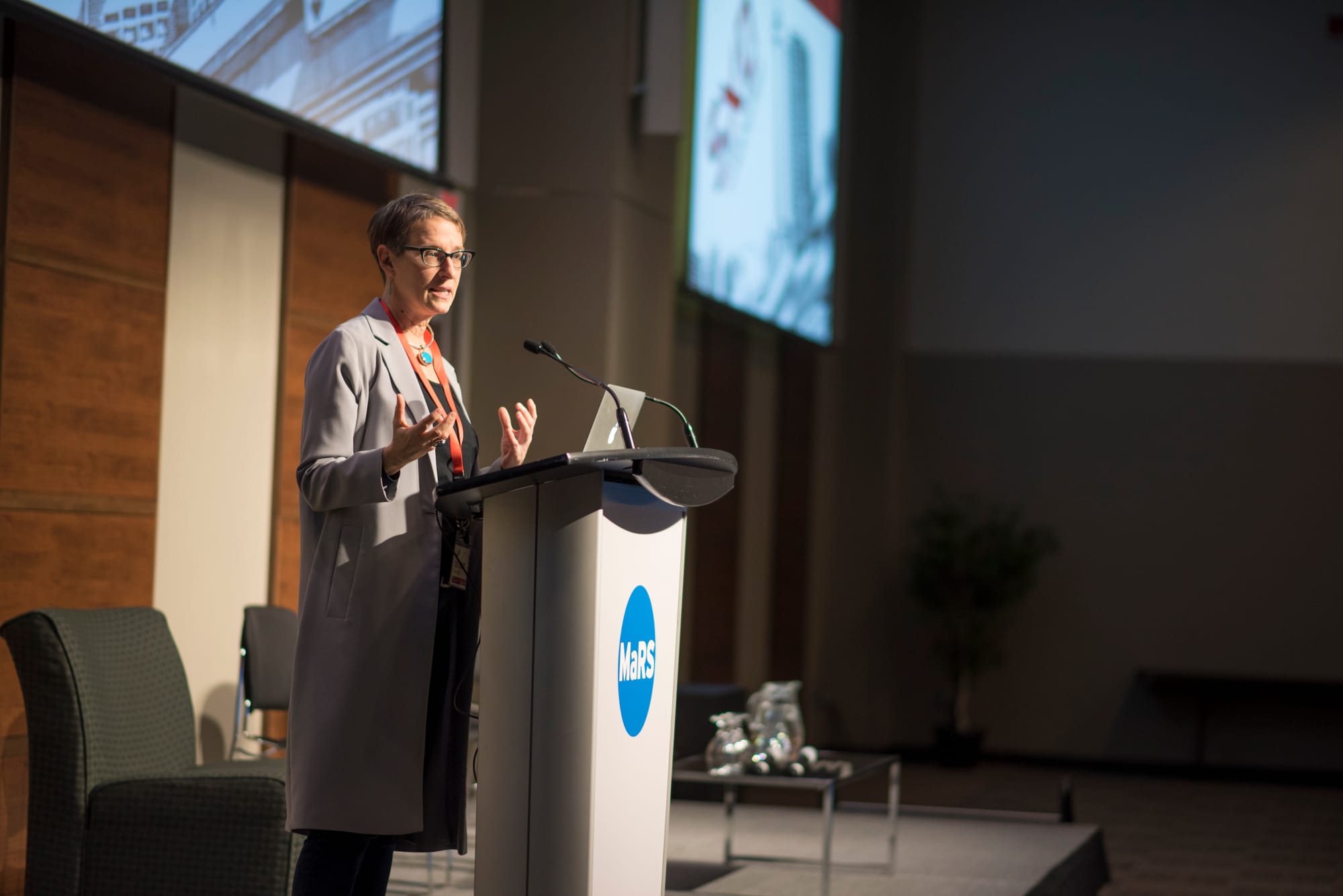
Photo credit: MaRS

I just spent the last 24 hours in MaRS (yes – in MaRS, not on it) exploring the emerging world of change labs.  The MaRS Discovery District is a collection of entities in downtown Toronto that share facilities and a passion for innovation.  This morning, it was also the site of a “fishbowl” dialogue among 20 change lab and innovation leaders, who gathered to explore the potential of and challenges to developing change labs for social innovation.

Change labs have been bubbling up across the country in the last couple of years, and have demonstrated promise in tacking complex social problems.  Now, thanks in part to the work of several organizations like MaRs, SiG and the BC Advisory Council for Social Innovation, interest in labs has piqued – and no where is it higher than in the public service.  Offering public servants a chance to escape the “swamp” in which they’re mired to explore ways to co-create new solutions to social problems with a variety of partners has the same effect as offering a Winnipeger an all-inclusive trip to Mexico in February.  Their faces split with a grin and they launch out of their chairs like a ski jumper going for gold.

This is all great for us at the Sauder Studio, as it confirms that we’re on the right track with our work  - teaching business students design processes and tools for solving wicked problems, in an attempt to change the way they think (and ultimately act).  Recently, we’ve expanded our programs to include external organizations, such as the BC Ministry of Health.  Still, when the theme of design education surfaced in the fishbowl today, I was keen to discover how these change-makers saw organizations like ours fitting into the lab movement.  It turned out that, leading the development and adoption of effective lab methodologies emerged as an obvious role for us to play.  Specifically, the group articulated a need to help folks in other countries learn to start and run change labs.

“What a great opportunity for us!”, I thought.  As I pictured this growing network of change labs around the world lighting little lamps of innovation everywhere, I realized that, at a certain point, the lamps will reach critical mass, eventually bathing the whole planet with their glow.  And it dawned on me – that’s what we’re working for.  That is the time when change becomes the norm.

So yes, change labs can and will play a key role in shifting our culture of innovation, by teaching those who use them to think and act differently.  But we may wish to consider them as a transitional tactic only.  Why limit the development of knowledge and skills in fostering social innovation to those working  within the lab community? Shouldn’t our ultimate goal be to increase our innovation capacity across all sectors, all industries, all disciplines?

Rather than looking for ways to just vacation from the swamp in the lab, why not re-invent life in the swamp instead, and re-plant it with something other than weeds?  Why not use change labs as seeds to sow a new culture; use them to help everyone learn to lead change?  Why not create a culture of innovation that is pervasive and desirable, that is normal – not an anomaly?

Lofty? Sure.  But a girl can’t just sit around!

The good folks behind Profit By Design generously invited me to attend their conference at Emily Carr University of Art and Design (ECUAD) last weekend, in my emerging role as the “something or other” at the Sauder d.studio.**  The two-day event featured a series of presentations and panels focused mainly on product and industrial design.  It was a good chance for me to rub elbows with some of the stalwarts in these fields from B.C. and the rest of the country.

It was no surprise that the theme of most sessions centred around the value-added to business by design processes and practices.  Everyone there agreed that design is a good thing for business. What was a surprise was that few have invested in actually measuring the ROI of design (at least in Canada). That is Problem Number One.  We need to show how we add value if we want clients to pony up for our services.

Problem Number Two?  The culture of design.  Apparently, “design club” is like fight club.  First rule?  Don’t talk about design club.  Because the bean counters and senior managers already think we’re weird and we don’t really want them to know what we do in our black box studios.  That sort of makes sense until we get to –

Problem Number Three.  Lack of design literacy.  Potential clients and funders don’t know what design is, how it works, or how it adds value.  We spend too much time and energy educating them, just to get them to buy into our services.

So, who can spot the real problem here?

We are our own worst enemies.  As long as we keep design club secret, our industry will struggle in obscurity.  This became one of the key subjects of the conference’s final event – an invitation-only round table to draft a national innovation strategy.  This is where Problem Number Four showed up. We keep trying to nail the perceived problem of lack of government support with the same hammer, by asking the feds for money to discuss the problem.  I heard stories about previous initiatives that sounded exactly like the session I was sitting in – and they had all failed.

The irony wasn’t lost on me.  Here was a room full of talented and senior designers, who all have years of experience in using decision processes to solve complex problems and foster innovation – and they couldn’t see that they were stuck in a pattern loop.  To drive a national innovation agenda, we need to apply our expertise and design processes to innovate a NEW way forward.

For many in the room, one of the obvious solutions is a plan to raise design literacy across Canadian sectors – particularly among business people.  What happy news for the d.studio at Sauder – we’re on the right track with our focus on design education!  In fact, in the few days that have passed since the conference, requests for information about our programs and services continue to pour in.

And that, my friends, is the best kind of problem to have!


** We’re developing a new role for me in the d.studio.  Best suggestion for my new title gets a Purdy’s Gift Box!!

I was lucky enough to spend 90 minutes visiting Christian Bason, Director of Innovation, at MindLab on a frosty day in Copenhagen last week.

Through the Sauder d.studio, Professor Moura Quayle and I have been invited to help shape a proposal for a new social innovation “change lab” in British Columbia with the B.C. Advisory Council on Social Entrepreneurship.  So I had a million questions for Christian, about governance, funding, scope, evaluation, ROI and citizen-centred design practice.  Christian literally wrote the book on innovation in the public sector (which, in Canada, seems an oxymoron).  He is, without a doubt, the most passionate (and interesting) civil servant I’ve ever met.

Photo: MindLab

He hosted me in the famous MindLab “dome”, a circular white ball lined from floor to ceiling with white-boards.  Our conversation soared from thirty thousand feet to ground level and back into the stratosphere as we explored the logistics, policy and pitfalls of managing such an enterprise in government.  To complicate things, MindLab actually serves three Danish ministries simultaneously.

I’ll continue to share insights and ideas from our discussion here over the next few weeks.  In the short term, these are my top take-aways for us to consider:

  • Invest serious time up front in strategic planning to define and scope the initiative. The MindLab team spent several days crafting their “theory of change” model, which serves as the foundation for all their work.
  • Start with the end in mind.  Don’t position this as a prototype or test.  Such an approach weakens commitment from both sponsors and participants.
  • Ensure that the sponsors are ready for and open to change – and are committed to the endeavour.  Change is hard and you don’t want them to panic at the first signs of resistance.
  • Develop a robust model to measure performance and impact early on.  Such metrics will inform and improve future operations and outcomes.
As one who has spent much of my life working on the bleeding edge of innovation, I recognize the wisdom of this last point in particular.  And it occurred to me well after our chat, that this is one of MindLab’s biggest strengths.  They operate in permanent beta.  Christian and his team continually evaluate and improve on their processes and outcomes.  In their quiet way, they model the essence of design for innovation:  good enough is never enough.  We know that reflection within the design process nurtures insight and ideas – it’s just good sense to include this in your own operational and strategic processes as well.
Follow

Get every new post delivered to your Inbox.

Join 235 other followers